Tuesday, December 22, 2015

Buzzer Management

Another one from Seth

I started the quiz team at my high school. Alas, I didn't do so well at the tryouts, so I ended up as the coach, but we still made it to the finals.

It took me thirty years to figure out the secret of getting in ahead of the others who also knew the answer (because the right answer is no good if someone else gets the buzz):

You need to press the buzzer before you know the answer.

As soon as you realize that you probably will be able to identify the answer by the time you're asked, buzz. Between the time you buzz and the time you're supposed to speak, the answer will come to you. And if it doesn't, the penalty for being wrong is small compared to the opportunity to get it right.

This feels wrong in so many ways. It feels reckless, careless and selfish. Of course we're supposed to wait until we're sure before we buzz. But the waiting leads to a pattern of not buzzing.

No musician is sure her album is going to be a hit. No entrepreneur is certain that every hire is going to be a good one. No parent can know that every decision they make is going to be correct. 

What separates this approach from mere recklessness is the experience of discovering (in the right situation) that buzzing makes your work better, that buzzing helps you dig deeper, that buzzing inspires you.

The habit is simple: buzz first, buzz when you're confident that you've got a shot. Buzz, buzz, buzz. If it gets out of hand, we'll let you know.

The act of buzzing leads to leaping, and leaping leads to great work. Not the other way around.

Monday, December 21, 2015

Checklists at the Docs

This is a small little habit that I'd developed, way back when I used to go see the doc for monthly checkups during pregnancy. Through the month, I'd jot down all the questions that came to mind, and carry the list to the doc each visit for answers.

That's a habit that just continued through the years......right through to now.

Might seem like a silly thing to do, but it's after all about our own bodies, of which we know so little ...........and there's always questions we have, but are either hesitant or forget, to ask.

And today when I read this, I realized it's something folks could actually make into practice.

Bringing Emotional Intelligence To Medical Care

A study of patients in physicians' waiting rooms found that each had an average of four or more questions in mind to ask the physician they were about to see. But when the patients left the physicians ' office, an average of only one or two of those questions had been answered. This finding speaks to one of the many ways patients' emotional needs are unmet by today's medicine. Unanswered questions feed uncertainty and fear. And they lead patients to balk at going along with treatment regimes that they don't fully understand.

And any treatment done under uncertainty has that less a degree of effectiveness.

Also, I find that when we ask the doctors, they are (mostly) more than happy to explain, with drawings and all. They just need to know you want to know.

It's like a small little cheat code for more efficient treatment....worth the try?

Sunday, December 20, 2015

Love and Merit

Excerpts from a NY Times article, Love and Merit,  by David Brooks

There are two great defining features of child-rearing today. First, children are now praised to an unprecedented degree.  They are given food, shelter and applause. 

The second defining feature is that children are honed to an unprecedented degree. The meritocracy is more competitive than ever before. Parents are more anxious about their kids getting into good colleges and onto good career paths and spend much more time investing in their children’s skills and résumés and driving them to practices and rehearsals.

These two great trends — greater praise and greater honing — combine in intense ways. Children are bathed in love, but it is often directional love. Parents shower their kids with affection, but it is meritocratic affection. It is intermingled with the desire to help their children achieve worldly success.

Very frequently it is manipulative. Parents unconsciously shape their smiles and frowns to steer their children toward behavior they think will lead to achievement. 

This sort of love is merit based. It is not simply: I love you. It is, I love you when you stay on my balance beam. I shower you with praise and care when you’re on my beam.

The wolf of conditional love is lurking in these homes. The parents don’t perceive this; they feel they love their children in all circumstances. But the children often perceive things differently.

Children in such families come to feel that childhood is a performance. They come to feel that love is not something that they deserve because of who they intrinsically are but is something they have to earn.

The shadowy presence of conditional love produces a fear, the fear that there is no utterly safe love; there is no completely secure place where young people can be utterly honest and themselves.

On the one hand, many of the parents in these families are extremely close to their children. They communicate constantly. But the whole situation is fraught. These parents unconsciously regard their children as an arts project.

This conditional love is like an acid that dissolves children’s internal criteria to make their own decisions about their own colleges, majors and careers. At key decision-points, they unconsciously imagine how their parents will react and guide their lives by these imagined reactions.  

Studies suggest that children who receive conditional love often do better in the short run. They can be model students. But they suffer in the long run. They come to resent their parents. They are so influenced by fear that they become risk averse. They feel driven by internalized pressures more than by real freedom of choice. 

Parents two generations ago were much more likely to say that they expected their children to be more obedient than parents today. But this desire for obedience hasn’t gone away; it’s just gone underground. Parents are less likely to demand obedience with explicit rules and lectures. But they are more likely to use love as a tool to exercise control.

But parental love is supposed to be oblivious to achievement. It’s meant to be an unconditional support — a gift that cannot be bought and cannot be earned. It sits outside the logic of the meritocracy, the closest humans come to grace.

Saturday, December 19, 2015

Walk - A Movie Review

A movie, (a true story), of how a seemingly impossible and crazy dream is made true.

The Walk Movie Poster

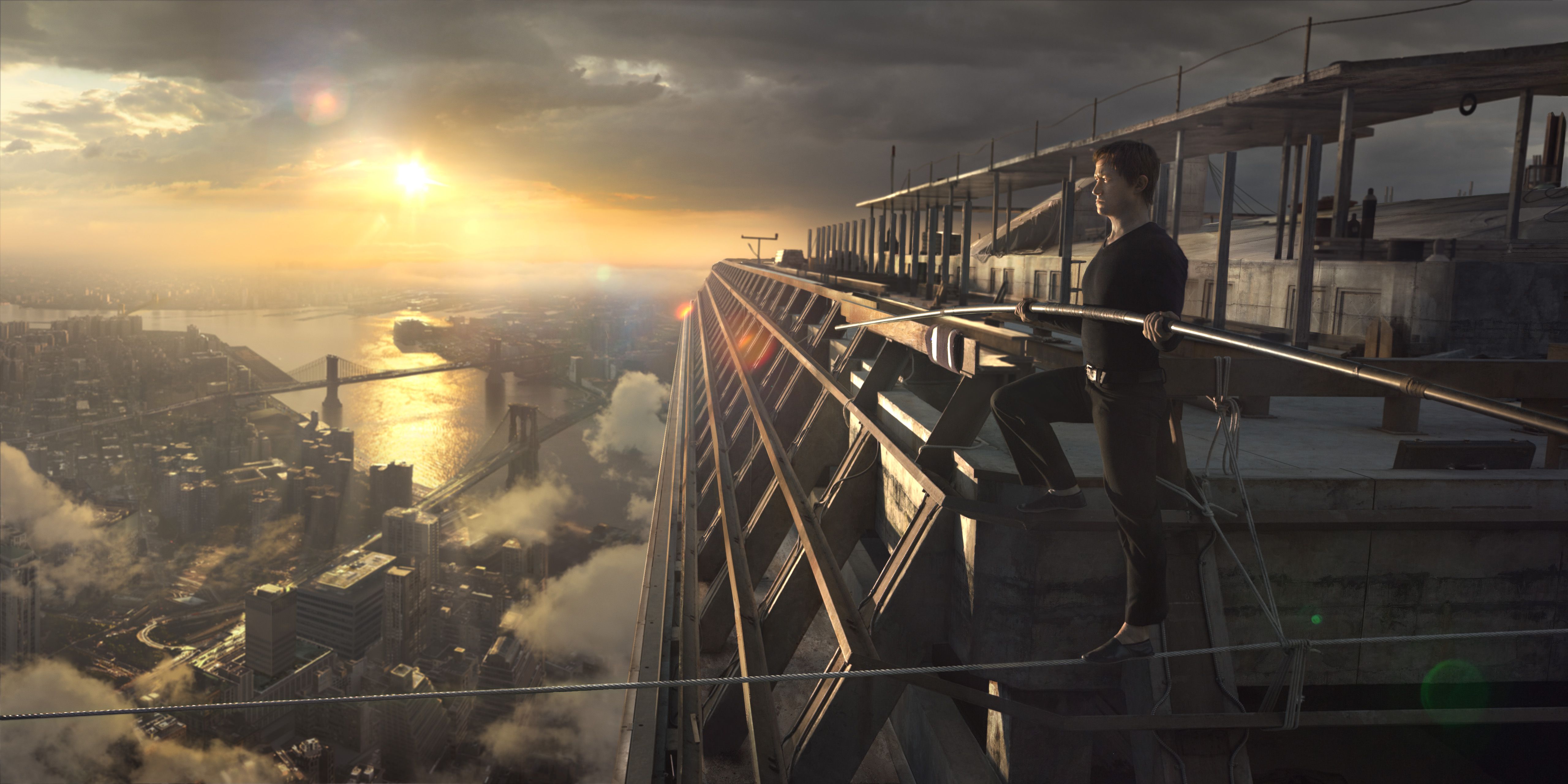
Philippe is fascinated with tight rope walking right since he watches the act in a circus at age four. It becomes his passion and his obsession and he grows to be a high wire artist. He is then looking for that perfect act....the artists coup as he calls it, when he sees a picture of the twin towers during a dentists appointment, yet under construction, and his mind is made up.

To walk a tight rope, without harness, between the twin towers.

In reality, this seemingly impossible stunt was done by Philippe Petit, a Frenchman, on Aug 7, 1974.

The photography or rather the cinematography brings out just how breathtakingly....insanely.... difficult and dangerous the whole walk is. I had difficulty sitting in one place and watching it on my laptop, and can just about imagine how it must have been on large screen and in 3D. I understand men went and threw up in the rest room.

Joseph Gordon Levitt, who plays Philippe is adorable and convincing...... with this boyish charm and hackneyed french accent, you can't help but feel with him. 

While before I watched the movie, the question in mind is 'why?...why would anyone want to do anything so crazy and meaningless?', within two minutes of the movie beginning, the question disappears and you're all set to go along with Philippe on his journey to his dream.

What does come through and stay beyond the passion and the belief, is the physical and mental precision of the process, the thoroughness and attention to detail which marks an extreme achievement.

A critical part was played by Ben Kingsley as Papa Rudy, a french daredevil, who is mentor to Philippe. He says, 'Stop, you're doing too much..no, you're still doing too much...do it from the heart, not out there'.....and Philippe understands that months later. The Aha moments. That was a defining relationship for sure. That it's such a beautiful and enriching relationship is really brought out when the real moment of glory, of achievement is shown not in NY with Philippe, but in Paris with Papa Rudy.

There's only moments where the stress gets the better of him, and his inner conflict, his tumultuous relationship with his wife and friends is left unexplored. (apparently, the earlier made, award winning, documentary by Marsh called Man on the Wire dealt with the complexities of his personality in more depth.)


And it's Robert Zemeckis' genius I guess that makes us experience, not just the lead up to the actual Walk, but the very Walk itself. You experience it physically through every step Philippe takes, the metallic creaking of the rivets, the rustle of the wind in his hair, the stress when it wobbles...and then the inside of his mind...the fear, the doubt, the audaciousness, the defiance and the glory.

This is the moment....the moment when all else fades away...just him and his dream 

Watch it to see how its a single , simple, horizontal line between an unbridgeable gap, across the void as he keeps saying, a void between where you are and where you want to be and how it gets bridged.

Also what clearly comes through is how once you're in the flow, the effort seems to fall away...it's then like music and poetry....a oneness that's almost spiritual in its intensity and beauty.

Friday, December 18, 2015

My First Tarot Reading

Tarot reading sure is a more esoteric practice than many others. It straight brings to mind a woman with loose hair, flowing robes, a crystal ball, dimly lit room..... foretelling impending doom.

It's really nothing like that.  There's nothing so mysterious or psychic about it. In fact Tarot reading doesn't even claim to predict or foretell ones future.

It is in essence a mechanism that enables you to connect to yourself, connect to the energy within the individual......and to the energy of the universe around the individual.

   
It's more of an incisive tool to self awareness. It's one way of enabling a delving into deeper layers of consciousness and then to how one connects to the possibilities and energies that surround you.

I've been learning and practicing for a few months now. Last week a friend happened to see the cards on the shelf, and asked if I would do a reading for her. 

I was game to try, though I told her I was yet learning and not a pro at it. She was interested, so I did a reading.....my very first. And was I was thrilled, when at the end of it she was like, 'that was really nice, and I could so connect to the cards....... and what you said sure gave perspective and pushed thought'. Fun, huh? 

Thursday, December 17, 2015

Repurpose, Reinvent.....Don't Retire

Retirement seems to suggest a binary perspective....Work...... or No Work.

It's like...I've worked all my life, and now I deserve the break. I had a responsibility...I needed to earn...I've done that for long years, so now it's time to indulge.

So what does this 'Break' mean? What does this 'Indulge' mean? They're pretty much myths.

Most folks find themselves at a loose end post retirement. There's an anxiety that's part of that transition, that seems to only grow with the years.........and the concern is not as much financial......... it's more about productivity, or closer home.........'relevance'. I start to wonder about my own Relevance. Especially today when sixty is nowhere near old age. It's only about how healthy you are. Age is a number. Don't let society delude you on that.

So let's see what differentiates the few.....the ones who on the other hand seem to grow in wisdom and stature as they go through their retirement.

I listed out about hundred folks to help think through this......and for those that made the cut ( the rare few), what one sees is this ability to switch off from what was, and find interesting things to do in the present.

Repurpose......Reinvent oneself......there's enough and more interesting things to do. Just know yours.

Also, throw out all the usual conditioning which comes with the thinking.

Work and Earning have gone so closely together, that at all points work....productivity...is gauged in relationship to how much it can earn you. And if it's not fetching you enough, then it's not worth it.

Let's move out of that frame. Money is needed for specifics and if those specifics are already taken care of, get money out of the way. That's one of the most liberating feelings ever.

It's no longer about the company or organization needing you ( it never was) , it's about what you as an individual want....let's accept that. 

What's more....this doesn't have to be a retirement stage occurrence....it would be good to take a raincheck every few years in life. Stepback to ask....Is this where I want to be? Is this what I want to be doing? Is this who I want to live with? Is this where I want to live?  Cliched as it sounds....it's about the now. 

Everyone around you will call you a fool....but then........it's about you, not them. It's your life. 

Be where you are...because, you want to be where you are. You choose.

Wednesday, December 16, 2015

Manganiyar Classroom

This was one of the most amazing show's I've ever seen. Sufi folk music in a play format, by children from the unbelievably talented performing muslim community, the Manganiyar Tribe from a village near Jaisalmer, Rajasthan. 


Sangeet humare khoon me behta hai (It runs in our blood) they said.......and it's just so visible. The children are maybe from seven to fourteen in age,  and the singing, the zeal, the rhythm, the beat..... like Diksha said, watching the little ones even when they weren't singing....they were still moving to rhythm...like they can't stay away from it.

And there's no recording, background music, amplification, nothing....it's their show all the way, and it keeps you riveted and mesmerized. 

The theme is basic.....children in a classroom...a normal typical teacher with a stick and the kids refuse to study. One teacher who understands them decides to connect with them through music, and he unleashes an energy that's seen through the overpowering music. It's again what we call the flow..they make it seem so effortless and beautiful.

While it's mostly singing, there are also little boys who play the drums and two very traditional instruments, the morchang and khartaal, both Rajasthani folk instruments. Actually, I didn't get why it's called Sufi...( to me sufi is distinctly urdu for one)..it's in the local marwari dialect, and distinctly folk. End of program, no one moved from their seats..... until the director stands and says...that's it guys. 

Roysten Abel, the theater director and playwright, known for his production  'Manganiyar Seduction' says '"It began when the non-profit trust, Bhoomija, from Bangalore approached me for a piece. I took this as an opportunity to work with the Manganiyar children. I felt that these children were so brilliant; when they come out of the wombs of their mothers, they come out singing. The women play the dhol and sing and the child is in between the dhol and the mother, so he grows up in a cocoon of music. What’s unfortunate is that most of them leave their music and take up other jobs, and become carpenters or drivers. Most Manganiyars cannot pursue their vocation'

This is RangaShankara, the auditorium that hosted the show. It's built by Arundhati Naag ( better known for her character as Vidya Balan's mother in Paa), to motivate and encourage art in Bangalore, and it's doing a wonderful job. 

Image result for ranga shankara\\

This is the cafe at the theatre, and if ever you visit....you get great akki roti here


And if you see 'Manganiyar Classroom' in your city, I'd think it would be nuts to miss it :)